"Tell them what to do and let them surprise you with their ingenuity."
— GEN. GEORGE S. PATTON
The 3 Keys for Successful Delegation
I am packing my bags again, going for my quarterly European trip, and this time I go with my son. It is great to be on the road, to meet new people, to establish new relationships and to strengthen old ones. It did not use to be like that — a few years ago I dreaded what would happen to my business when I was gone. I tried different ways of delegation, but it seemed that none really worked out well.
My return day was always a day of fear and worry. Would my store be in decent shape? Would clients call me to complain? Have orders been filled to the satisfaction of my clients?
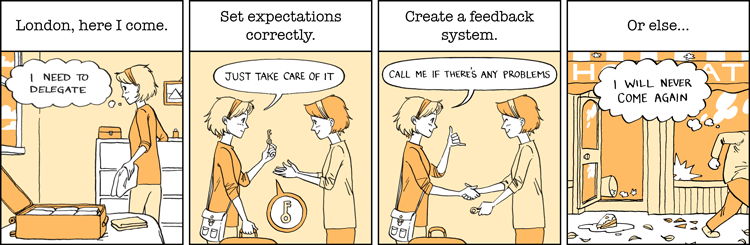
Back then, I thought delegation started and ended with telling my friend what my responsibilities were and how I did them. I gave her the manual of my own store procedures. I gave her the store keys. I gave her all the necessary phone numbers and told her, "I will come back in a month, call me if there are any problems." Guess what — she never called, and when I came back there were always problems.
I know better now. I didn't delegate my responsibilities to my friend — I abdicated my responsibilities and went away. Can you tell the difference between delegation and abdication?
In my mind, the main difference is not necessarily in the details about how to do things, or giving detailed phone numbers and contacts, it is not even being available for emergency. I believe great delegation is comprised of 3 key aspects:
1. Plan & Expectations — Create a detailed explanation of what needs to be done and what your expectations are. For example, I tell her that she will need to fulfill all orders on time, she will need to open the store between 8am and 8pm, and she will need to track future orders and inventory levels. It is important to clearly define how you will measure success.
2. Reporting system — Develop a daily/weekly/monthly reporting system. A reporting system is a way for her to report back to me key indicators which give me the ability to measure the business's health. It can be weekly inventory numbers, weekly revenue numbers, or daily key client complaints, if any. Using this reporting system helps both of us communicate on specific issues. It usually doesn't take more than a 5-10 minute daily call — sometimes an email is enough. No abdication — delegation with reporting!
3. "What to do if" plan — It's not "call me if there are problems," but a short guide of things which may go wrong and what to do in case it happens. It can be what to do when a delivery is late, what to do when the refrigerator breaks, or what to do if a client wants to cancel an order that's already been filled and shipped.
I'm sure you've guessed by now that these 3 keys apply to any type of task or work delegation. It enabled my business to not only function when I'm away, but to grow when I'm away. I'm happy to go to Europe. I know I have a great delegation plan. I know I don't need to worry about my business. How do you delegate tasks?
— Liz
✦ ✦ ✦
"We are what we repeatedly do. Excellence is not an act, but a habit."
— ARISTOTLE
How Do You Create a Customer Habit?
It is Thursday evening, time to strategize before the busy weekend. It has become a habit of mine to always meet Charlie on Thursday evening and speak about making the business better. Charlie starts by saying, "Habit is both a good thing and a bad one — as Vince Lombardi said once, winning is a habit, unfortunately, so is losing." Charlie loves quoting smart people.
Charlie continues: "Today, I want us to talk about increasing your business's competitive advantages, and mainly I want us to talk about customer captivity — the importance of creating your business's product as a habit in your client's life."
"Charlie, I'm not sure I understand. We spoke a lot about creating a better product, better customer service, always delivering on my promise — isn't that enough to attract my perfect clients to my store?"
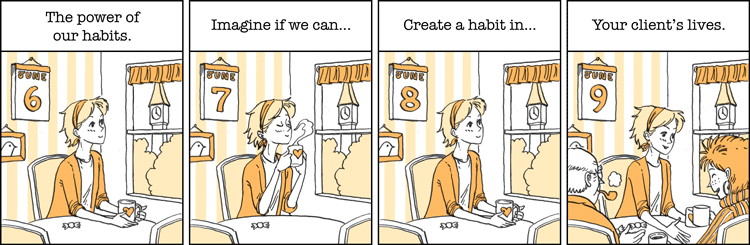
Charlie smiles and says, "These are all important, but great companies are doing even more. Great companies can create an 'addiction' to their product by encouraging consistently high frequency of use of their products or services. They are creating a habit of consumption."
He continues: "By creating this recurring 'addiction,' great companies will have greater customer captivity and a competitive advantage over companies that have to convince their customers to buy their product every single time instead of just the first time. As an added bonus, companies with habits of consumption will have greater pricing power, as well."
He asks me to think about some of the products I and my customers use on a daily basis: Where do they get their coffee on the way to work? Why do you think daily soap operas are daily? What's the first website you visit each morning?
I ask Charlie, "How do companies increase their customers' habit?" Charlie says, "Habits emerge because our brain is constantly looking for ways to be more efficient, to be automatic. There are 3 parts for a habit to be triggered. The first is a cue that lets our brain know it's time to look for a predefined pattern we should act upon. The second part is a routine, which is really our activity. And the last part is the reward."
I jump on my feet: "There's this wonderful ice cream store down the shore — every time we're on our way home after a day at the beach, we stop there. We don't even think about it, we just stop." Charlie smiles: "This is an excellent example, Liz. The key — the engine — to turning on our habits is our craving. This craving is almost unnoticed at the start, but eventually we associate it with the cue, and it becomes automatic."
Charlie looks at me and says, "Let me quote Warren Buffett — the chains of habit are too light to be felt until they are too heavy to be broken." Lesson delivered.
I'm already thinking how I can help my clients have a great summer habit of eating my Italian high-quality ice cream. It will be a unique and repeatable experience, bringing good memories of families eating together, refreshing themselves with unique flavors every few days — a habit they'll cherish for the rest of their lives. It is fun to create sweet habits.
How do you create great habits in your clients' lives?
— Liz
✦ ✦ ✦
"The purpose of a business is to create a customer."
— PETER DRUCKER
The 4 Questions to Attract Your Perfect Client
A few years ago, when I just opened my little venture, I had one really annoying client — you know the type. He'd come in, ask questions, ask to try some products, ask some more questions, and at the end of his visit might purchase just one piece of chocolate, on a lucky day, and leave.
"It's not fair," I told Athena. She looked at me, half entertained, half questioning. "I know, I know, I should be happy having any client — but I know there are better clients out there. Why doesn't he respect my time and my business?"
Athena put her hand on my shaky hand and said, "Liz, every business owner gets the clients they deserve." That's exactly what I needed to hear — yeah, right. She reached into her bag, pulled out a book, and said, "Liz, read this, and once you're done we can talk more."
I looked at the cover: "Attracting Perfect Customers." I had always been told that once I built a valuable product, clients would come. Can I really attract the clients I want?
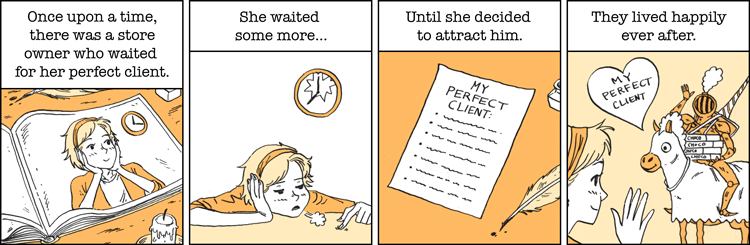
I read the book all night long — I was fascinated. I realized it is up to me to attract my clients. It is up to me to define who I want my business to attract. I can actively work on getting the perfect clients — the clients my business deserves.
Success is not necessarily defined by getting more clients. It can be defined by getting the right clients — the clients who are perfect for my business, for my vision, for me, and I for them.
One of the exercises I liked most was defining my perfect client. Before you start, grab a notebook, and promise to write at least three answers to each question before moving to the next one.
Write at the top of your page: "My perfect client is…" and list at least three qualities. Here are some of mine: honest, having a great sense of humor, treats me with great respect, willing to listen and learn, enjoys and appreciates her good life.
Next, write: "What makes my perfect client tick?" Mine: being around her family and surrounded by good friends, striving to be the best in her vocation, traveling and experiencing new places and tastes.
Then: "I choose my perfect client to expect me to…" Mine: be honest and trustworthy in all my affairs, provide inspiring products in a unique and welcoming environment, create an oasis of sweetness and security, change her life by exploring new ideas, tastes, and experiences.
To make this exercise powerful, write at least 10 points for each question. It's not a 10-minute exercise — it's not urgent, but it is important.
Finally, write: "I commit that my company will serve ____ perfect clients in the next 12 months!" Challenge yourself. How many new perfect clients do you want? How many lives do you want to impact?
Athena knocks on the door — she's always my first customer on Saturday. Athena is my perfect client, and I am so happy.
— Liz
✦ ✦ ✦
"Let us never negotiate out of fear. But let us never fear to negotiate."
— JOHN F. KENNEDY
How Do You Negotiate? — Part 1
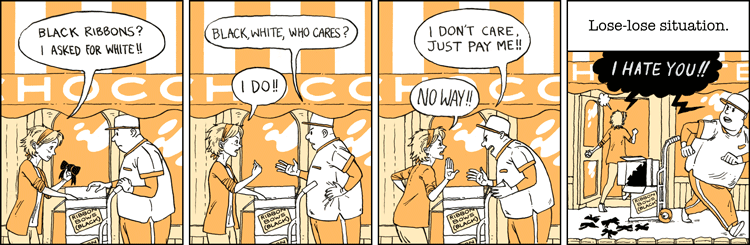
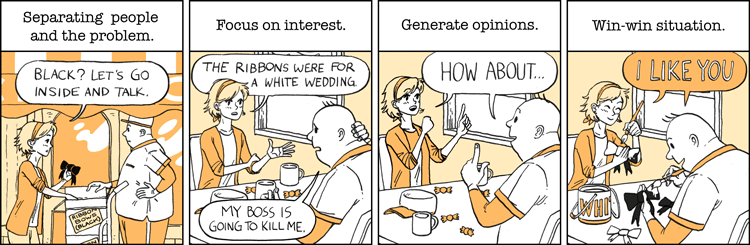
Liz: "I told you I need white ribbons!" Delivery Guy: "Well, you never said it needs to be white, you only said you need 1,000 ribbons for a wedding!" Upset Liz: "What's wrong with you? It is a white wedding, not a funeral." Furious Delivery Guy: "You are impossible to negotiate with."
We all need to negotiate. We all face conflicts. It's part of life, and part of a business owner's life. A lot of my friends constantly try to avoid conflicts — going through life without ever upsetting anyone. Sounds great, right? No conflicts, no bad feelings. But can we really do it? Can we really go through life without ever facing a conflict?
Conflicts happen, it's a fact. Disagreement happens, it's a fact. What you do is the key. The "easiest" way is to just agree with the other side — no conflict, no mess. But do you see the problem? I know you do.
"If we need to do it, why not learn how to do it right." It took me many years to learn how to negotiate — I am still learning. The first step for me was realizing I can't be afraid to negotiate. I can't continue to avoid every conflict.
I wanted to learn how to handle conflicts so I could learn more about myself and about others. I wanted to achieve the elusive win-win situation.
I remember telling Charlie about my black ribbons day. It was supposed to be my store's first big wedding order — I had 1,000 purple boxes filled with white chocolate shaped as two hearts, and I'd ordered white ribbons. The delivery guy arrived with a box full of neatly arranged black ribbons. I almost cried.
As I told Charlie the story, tears dropped from my eyes. He handed me his handkerchief. I told him I'd failed. Charlie looked at me and said, "You only fail if you refuse to learn — there is no failure, only learning." He picked up his elegant brown suitcase and pulled out a book: Getting to Yes. "Please promise me to read it before my next post!"
My first learning from the book: when faced with a conflict, we have to separate the people from the problem. I was so upset with the delivery guy, and he was so upset with me. We focused on the people instead of the problem. We got emotionally attached to our feelings instead of thinking clearly about the problem itself.
Our perceptions lead us to interpret facts differently. The fact is, we had a box of black ribbons. But I interpreted it as "he didn't care," and he interpreted it as "she never told me white." We blamed each other instead of understanding each other.
Think about your latest conflict — what were the real facts, not your interpretation of them? I now believe both sides must understand the other's viewpoint before coming up with proposals.
— Liz (a beginner in negotiation, but eager to learn more)
✦ ✦ ✦
"There is only one way to get anybody to do anything."
— DALE CARNEGIE
How Do You Negotiate? — Part 2
Charlie took another sip of his hot chocolate. We were talking about how to negotiate, continuing from where we left off — I already knew I must do it, and now it was time to learn how to do it right.
Step one — separating the people from the problem. I told Charlie that many times I let my perceptions about a person or situation cloud the real facts. I get so upset when things don't work out that I end up playing the blaming game. Charlie asked, "Liz, what do you think the delivery guy's perception of you was?" Maybe understanding the other side is the best way to start a negotiation.
Charlie explained the other two problems when people negotiate: emotions and communication. I told him that when the delivery guy brought the black ribbons, I was so afraid I'd ruin the most special day in a girl's life. Charlie told me the key in negotiation is not to hide your feelings but to acknowledge them — it's okay to tell the other side how you feel.
He also talked about communication — that in the heat of negotiation we're so consumed by what we want to say that we ignore the other person's words entirely. "Sometimes this is the reason for a failed negotiation. Your goal is not to leave the room the strongest — the goal is to understand and be understood." The trick: before you speak, repeat or summarize the other person's points first.
Step two — focus on interests. "Good agreement focuses on people's interests, not their position." My position was that I wanted white ribbons; the delivery guy's position was that he'd provided expensive ribbons and wanted to be paid. But my actual interest was to provide an amazing and sweet moment to the wedding guests. We all share some basic interests — we all want to feel secure, to be understood, to be loved. We are all people.
Step three — generate options. "You and the other party need to generate creative options for mutual gain." One obstacle to a win-win is that we jump to a solution before exploring alternatives. The goal is to generate as many proposals as possible first, and only then start evaluating and narrowing them down.
Step four — use objective criteria. "Sometimes interests are directly opposed." Both sides can agree on objective criteria — professional standards, legal or scientific findings. Deciding on the criteria is almost a negotiation of its own, but it really helps to explain your reasoning and listen to theirs.
Once we narrowed our proposals to the most promising ones and agreed on objective criteria, something almost magical happened — we agreed on a solution. Both of us gave a little, but both of us gained a lot. It was a good day painting the ribbons white. I like Joe the delivery guy. I like him a lot.
Don't ever back away from a conflict — embrace it. You might find a new you.
— Liz (a beginner in negotiation, and now a fifth-time reader of Getting to Yes)
✦ ✦ ✦

"Why do we fall? So we can learn to pick ourselves up."
— BATMAN BEGINS
The Power of Failing
Today has been one of those days — you know, the day nothing works out. I had a big order coming in and the guy just bailed out on me at the last moment. What should I do now with 100 boxes of chocolates, each engraved "honey bunny" on a white bunny shape?
At the start, I rejected the option of failing. Failure is not an option, I told myself. I worked so hard, so many long hours. No vacation, just the store, home, kids. Doing, doing, and doing.
And then one day I failed — I delivered the wrong chocolate order and missed my daughter's ballet class. It was painful. I did not want to feel this again. I was afraid.
I decided to make sure I would never fail again — and I found the way to avoid failure was by not trying "unsure" things. I stopped taking orders that forced me to think creatively. I stopped conducting special events. I stopped looking for new clients. I even stopped baking my special Friday cakes. I did not want to feel that pain again. I even thought about closing the store.
"Why do we fail, Liz?" Charlie asked me once. I had always thought we should never allow ourselves to fail — I'd never really thought about the reason for failing. Charlie said, "We fail so we can learn from our mistakes and get back up. We fail in order to learn how to do things differently, how to do it better next time, how to get up."
I've thought a lot about those words since. I now believe people who want a "no failure guaranteed life" also unknowingly guarantee something else — if I make sure I never fail, I also make sure I never try anything new. I will not move forward. I will be stuck where I am, while my competitors, my clients, my friends, all move forward.
So now I embrace the lessons I learn from my failures. It's still painful to go through one, and I still do whatever I can to avoid failing — I keep my systems in order, I take control of what's under my control — but I no longer let the fear of failure stop me from trying new things. I know now: if I fail, I will get up with new insights under my belt.
I learned to crave the learning, the insights. I want my kids to never be afraid to try, to see failing as learning, to see how I get up. Because who really wants to fall and stay down? It's much more fun to get up.
Now, what should I do with all those white bunnies?
— Liz
There's a Japanese phrase my master taught me: "Nana Korobi Ya Oki" — "Fall Down Seven Times, Get Up Eight."